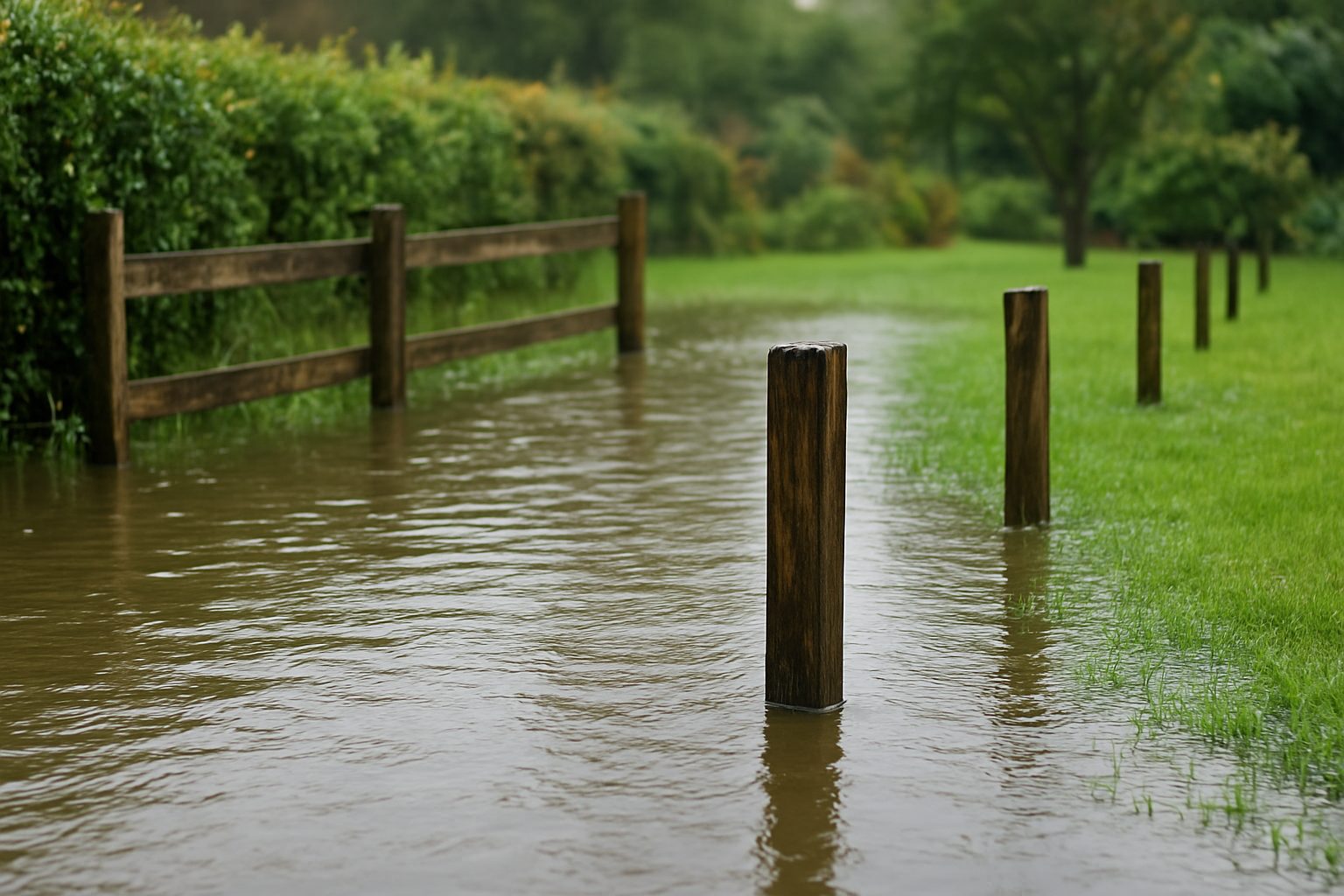
There is a particular type of garden I come across regularly in York. It looks perfectly respectable through summer, with a decent lawn, tidy borders and a fence that appears to be doing its job. Then November arrives, the rain settles in, and suddenly the bottom of the garden resembles a muddy field. Water gathers around the fence posts, the grass turns soft underfoot and the gate starts catching. It is often at this point that homeowners begin looking into grounds maintenance in York, although the underlying problem may have been developing for years.
Poor drainage is one of those issues that rarely attracts much attention until it becomes difficult to ignore. A few puddles after heavy rain are normal. Water that remains for days, leaves the ground permanently soft or regularly collects against buildings and boundaries is another matter.
After years working with fencing and garden boundaries, I have become convinced that drainage deserves far more attention than it receives. People spend good money replacing rotten fence posts without asking why they rotted so quickly. They install expensive patios without considering where the rainwater will go. They raise lawns to make gardens look level, only to push the water towards the neighbours.
The frustrating thing is that many of these problems are avoidable.
York’s Ground Conditions Can Make Drainage Difficult
York does not have one uniform soil type. Ground conditions vary considerably across the city and surrounding villages, influenced by historic rivers, glacial deposits, clay-rich soils and areas of land disturbed by previous construction.
Some gardens drain reasonably well. Others hold water for days after prolonged rainfall.
Heavy clay is particularly troublesome because water passes through it slowly. Once the ground becomes saturated, additional rain has nowhere obvious to go. It collects in low spots, runs across the surface or sits around structures such as fence posts and retaining walls.
I have encountered gardens where the top layer of soil looked perfectly healthy, but digging down revealed dense, sticky clay. During wet weather, the soil clung to the spade and held its shape almost like modelling clay.
That is not necessarily a problem in itself. Plenty of gardens with clay soil function perfectly well. Difficulties arise when drainage is restricted further by landscaping, compacted ground or changes in level.
New-build gardens can be especially awkward where construction traffic has compressed the soil. Older properties present different challenges, including buried rubble, old paving and drainage arrangements that have been altered over decades.
The important point is that a drainage problem cannot be diagnosed from the surface alone.
Why Waterlogged Ground Causes Fence Posts to Move
Most people associate wet ground with timber rot. That is certainly part of the problem, but there is another issue that can be just as damaging.
Movement.
A fence relies on its posts remaining firmly supported by the surrounding ground. When soil becomes saturated, its ability to resist movement can change, particularly where the original foundations were shallow or poorly installed.
A six-foot solid fence catches considerable wind pressure. During a winter storm, that pressure transfers through the panels and rails into the posts.
If the surrounding soil is soft and the foundations are inadequate, the posts may begin moving.
The first signs are often subtle. A fence that was straight in September develops a slight lean. A gate becomes difficult to close. Small gaps appear around concrete footings.
By January, the movement may be much more obvious.
I have removed fence posts where the concrete itself remained intact, but the entire footing had loosened within the surrounding soil. The problem was not necessarily the concrete mix. It was the combination of poor ground support, inadequate foundation design and repeated loading.
Simply replacing the post in the same way would have achieved very little.
That is why I always want to understand what caused the failure before recommending a repair.
The Bottom of the Garden Is Often the Wettest
Many gardens slope gently away from the house. This can be useful because surface water naturally moves away from the building.
Unfortunately, the water still needs somewhere to go.
If the rear boundary is slightly lower than the rest of the garden, rainfall can collect along the fence line. A solid boundary wall, raised neighbouring garden or poorly positioned landscaping feature may prevent it from draining away naturally.
I have seen gardens where the rear metre remained wet long after the rest of the lawn had dried.
The homeowner assumed the fence was causing the problem.
In reality, the fence was simply sitting in the lowest part of the garden.
Replacing the panels would not improve the drainage.
In some cases, carefully planned surface drainage can help. Elsewhere, the solution may involve changing ground levels, improving soil structure or installing a suitable drainage system.
The correct approach depends on where the water originates and where it can safely discharge.
Digging a trench without understanding either of those things is not a drainage plan.
Raised Patios Can Redirect Water Into Unexpected Places
Patios are another common source of drainage trouble.
A homeowner replaces an old lawn with paving, creating a clean seating area that requires less maintenance. The finished surface looks excellent, but nobody has properly considered how rainwater will leave it.
Previously, some water could soak into the ground.
Now it runs across a hard surface.
If the paving falls towards the garden boundary, the water may collect against the fence or flow into a neighbouring property.
This is particularly problematic in smaller terraced gardens where there is limited space for drainage features.
I have seen patios installed with the wrong fall, leaving water sitting against timber posts or pooling near a gate.
Sometimes the problem only becomes obvious during prolonged winter rain.
A properly designed patio should have suitable falls and a drainage arrangement appropriate to the site. Depending on the layout, this may involve permeable construction, drainage channels or another approved means of managing surface water.
There are also planning and drainage rules to consider, particularly for some front garden paving projects.
The sensible approach is to address drainage during the design stage rather than after the slabs have been laid.
The Problem With Raising Garden Levels
Another mistake I see is raising the ground without considering the consequences.
It often starts with a reasonable idea. The homeowner wants a flatter lawn, a larger seating area or a garden that is easier for children to use.
So soil is brought in and the low sections are filled.
Unfortunately, raising one part of a garden changes how water moves across it.
Rain that previously collected in one area may begin flowing towards the house, a neighbouring boundary or an existing patio.
There is also the question of soil pressure.
If the new ground level sits against ordinary timber fencing, the bottom boards may remain damp for long periods. Worse still, the fence may begin acting as a retaining structure.
Standard garden fencing is not designed to hold back substantial amounts of saturated soil.
The weight can place considerable pressure on the posts and panels.
Where a change in level requires retaining soil, a suitable retaining wall or engineered structure may be necessary.
I would rather see a properly designed retaining feature installed once than spend years repairing a fence that was never intended to support the ground behind it.
Why New-Build Gardens Can Be Particularly Wet
New-build developments often receive criticism for garden drainage, although the causes vary from site to site.
One common issue is soil compaction.
During construction, heavy machinery and repeated vehicle movements can compress the ground. This reduces the spaces through which water would normally move.
The developer may then spread a relatively thin layer of topsoil over the compacted material before laying turf.
The finished garden looks perfectly acceptable.
But during wet weather, water can struggle to pass through the compacted layer beneath.
I have seen lawns where the turf could be lifted to reveal a dense, poorly draining surface underneath.
Simply adding more topsoil would not necessarily solve the problem.
The underlying ground may need assessment and suitable remediation.
Drainage arrangements also matter. Some developments have designed surface water systems, and changes made by individual homeowners can interfere with how those systems operate.
Before carrying out major alterations, it is worth checking whether existing drains, soakaways or other features serve the property.
The same applies to fencing foundations. Digging near buried drainage infrastructure without knowing its location can create expensive problems.
Older York Gardens Have Their Own Drainage Problems
Older properties are not automatically better.
Gardens around South Bank, Holgate, Clifton and other established parts of York may have been altered repeatedly over many decades.
Old paths get buried.
Outbuildings are demolished.
Patios are laid over earlier surfaces.
Drainage pipes are diverted or abandoned.
Eventually, the garden becomes a collection of different materials and levels.
I have dug post holes where the first section contained decent soil, followed by broken brick, compacted rubble and a layer of heavy clay.
Water behaves differently through each of those materials.
A buried concrete slab can also prevent water moving down through the ground, forcing it sideways towards a fence or building.
These problems are not always obvious during a visual inspection.
Sometimes the only way to understand the ground is to investigate it properly.
That is why I would be cautious about anyone promising a simple drainage solution without examining the site.
A French Drain Is Not Always the Answer
French drains are frequently suggested for wet gardens.
They can be useful, but they are not a universal solution.
A typical French drain uses a gravel-filled trench, often containing a perforated pipe, to collect and convey water.
The important word is convey.
The water needs somewhere suitable to go.
If a trench simply collects water in heavy clay with no effective outlet, it may become little more than an underground reservoir.
I have seen homeowners spend money digging trenches along fence lines without establishing whether the water could actually drain away.
During prolonged rainfall, the trench fills and the surrounding ground remains wet.
A properly designed system needs to consider soil permeability, levels, available outlets and the volume of water involved.
Soakaways can work in suitable ground, but their performance depends on infiltration rates and appropriate positioning.
They are not automatically suitable for every clay-rich garden.
Where drainage affects buildings, neighbouring properties or existing infrastructure, specialist advice may be needed.
It is better to investigate properly than install a system that only moves the problem somewhere else.
Timber Fencing Needs Protection From Persistent Moisture
Timber can cope with ordinary British weather when it is correctly specified, treated and installed.
What it does not appreciate is prolonged contact with wet soil.
The area around ground level is particularly vulnerable because moisture and oxygen are both present.
Over time, timber posts can deteriorate at this point, even when the buried section appears reasonably sound.
Pressure treatment helps, but the treatment specification matters.
Timber intended for ground contact should be appropriately treated for that use. A decorative fence panel and a structural post do not necessarily require the same treatment level.
I would also avoid allowing soil, mulch or garden waste to build up against timber gravel boards.
Concrete gravel boards can provide useful separation between panels and damp ground, although they do not solve the drainage problem itself.
Where a garden remains persistently wet, concrete or suitable metal posts may be worth considering.
The choice depends on appearance, budget, ground conditions and the type of fencing being installed.
A properly designed timber fence can still be a good option. It simply needs the right materials and foundations.
Gates Often Reveal Drainage Problems First
Garden gates are surprisingly useful indicators of ground movement.
Unlike fence panels, gates are opened and closed regularly. Their weight places repeated loads on supporting posts.
If a post begins moving, the gate often shows it before the rest of the fence.
The latch stops lining up.
The bottom catches on paving.
The gap becomes wider at the top than the bottom.
Sometimes the homeowner trims the gate to make it fit again.
That may provide temporary relief, but it does not address a moving post.
I would always inspect the supporting structure before cutting timber away.
Wet ground is not the only cause of gate movement, of course. Hinges can loosen, timber can swell and frames can distort.
But where a gate repeatedly drops during winter, the post foundations deserve attention.
When Fence Repairs Are Worthwhile
Waterlogged ground does not automatically mean the whole fence needs replacing.
Sometimes the damage is limited to one or two posts.
If the remaining structure is sound, targeted repairs may be perfectly sensible.
However, the replacement posts need to be installed with the ground conditions in mind.
There is little value in removing a failed post and installing another with exactly the same inadequate foundation.
A proper assessment of fence repairs in York should consider why the original structure failed.
Was the timber rotten?
Had the concrete footing moved?
Was the post too shallow?
Did water collect around the base?
Was the fence exposed to unusually strong wind?
The answers affect the repair method.
Where several posts have failed along the same wet boundary, a more substantial solution may be necessary.
That could involve replacing the affected run, improving drainage or changing the foundation design.
The aim should be to avoid paying for the same repair repeatedly.
Waterlogging Can Damage More Than Fencing
A persistently wet garden affects other features too.
Lawns become difficult to maintain. Grass roots struggle in saturated soil, particularly where the surface is compacted by regular foot traffic.
Paths can settle or develop standing water.
Timber decking may remain damp for long periods, encouraging algae growth and making surfaces slippery.
Raised beds can become saturated if they lack suitable drainage.
Even established shrubs may suffer where their roots remain waterlogged.
This is why drainage should be considered as part of wider garden maintenance rather than treated solely as a fencing problem.
Sometimes improving the condition of the soil and managing surface water can benefit several parts of the garden at once.
But the solution needs to match the cause.
A lawn with compacted soil may benefit from appropriate aeration and soil improvement. A garden receiving runoff from a large paved area may require a more substantial drainage arrangement.
Those are different problems and should not be treated as though they are interchangeable.
Autumn Is the Time to Watch Where Water Goes
October and November are useful months for assessing garden drainage.
Rather than waiting until the ground is completely saturated, pay attention during the first prolonged periods of autumn rain.
Look at where water collects.
Does it run off the patio towards the fence?
Does the lawn remain wet in one particular corner?
Is water flowing from a neighbouring garden?
Are downpipes discharging onto the ground?
Does the gate area become muddy?
These observations can reveal patterns that are difficult to identify during dry weather.
It is also worth checking gutters and downpipes. A blocked gutter or damaged downpipe can release a surprising amount of water into one small area.
I have encountered situations where a homeowner suspected a serious underground drainage problem, only to discover that rainwater from the roof was being discharged directly beside the fence.
Fixing the source was considerably simpler than installing an entirely new garden drainage system.
Be Careful About Sending Water Into a Neighbour’s Garden
Drainage work should not create problems for adjoining properties.
This sounds obvious, but it is easy to overlook during landscaping.
Raising a patio, changing ground levels or installing drainage channels can alter the direction of surface water.
If the new arrangement concentrates runoff towards a neighbouring property, it may cause damage or lead to a dispute.
The fact that water naturally flowed in a particular direction before the work does not automatically justify redirecting additional runoff there.
Where boundaries are shared, it is worth discussing substantial changes before work begins.
For complicated sites, professional drainage advice can help establish an appropriate solution.
The aim is to manage water responsibly, not simply move it out of sight.
What I Would Check Before Replacing Fencing in a Wet Garden
If I were inspecting a fence in a garden that regularly becomes waterlogged, I would start by looking beyond the damaged posts.
I would want to understand the direction of the slope and where water gathers after rain. I would check whether nearby paving or raised beds are directing runoff towards the boundary.
Then I would examine the posts and their foundations.
A rotten timber post tells a different story from a sound post sitting in loose ground.
I would also look at the condition of the gravel boards, rails and panels. If the fence has been exposed to persistent moisture for years, several components may have deteriorated together.
The surrounding landscaping matters too.
A new patio, extension or raised lawn may have changed drainage patterns since the fence was installed.
Sometimes the best repair involves replacing damaged posts and making a small adjustment to the surrounding ground.
Other times, the drainage needs attention before any new fencing goes in.
There is no point installing a new boundary if the conditions that damaged the old one remain unchanged.
The Cheapest Drainage Fix Is Often the One You Make Early
Garden drainage problems have a habit of becoming more expensive when ignored.
A small area of standing water might initially affect nothing more than a patch of lawn.
Over time, persistent saturation can contribute to damaged fencing, unstable paving and deteriorating timber structures.
That does not mean every puddle requires excavation.
Some gardens simply need better maintenance, improved soil condition or a minor adjustment to how surface water is managed.
Others have genuine drainage defects that require investigation and more substantial work.
The important thing is recognising the difference.
I would be suspicious of anyone who recommends digging trenches or installing expensive drainage systems before understanding where the water comes from.
Equally, I would not dismiss a garden that remains saturated for days after ordinary rainfall.
Water has to go somewhere.
If it cannot move through the soil or reach a suitable drainage outlet, it will collect in the lowest available place.
A Good Fence Starts With Understanding the Ground
People often judge fencing by the panels they can see.
They compare timber thickness, decorative finishes, post styles and the colour of composite boards.
Those things matter, but the ground underneath deserves just as much attention.
A strong fence installed in unsuitable foundations can still fail. Expensive materials cannot compensate for poor drainage or unstable soil.
That is particularly relevant in York, where ground conditions can vary considerably between properties and even across the same garden.
I have always preferred dealing with the cause of a problem rather than repeatedly repairing the damage it creates.
If a fence post has rotted because soil has been piled against it, remove the soil and address the timber.
If a footing has moved because the surrounding ground is unstable, investigate the foundation.
If water collects along the boundary every winter, work out why before installing another fence in exactly the same position.
Sometimes the answer is straightforward. Sometimes it requires proper drainage work.
Either way, a few hours spent understanding the ground can prevent years of frustration.
And if your garden is already turning into a muddy mess this autumn, I would pay attention to where the water is sitting before the first hard frost arrives.
The fence might be the most visible casualty, but it is rarely the only part of the garden affected.
Key Takeaways
- In November, gardens in York often become waterlogged, revealing drainage issues that homeowners typically overlook until substantial problems arise.
- York’s diverse ground conditions, influenced by various historical and geological factors, can lead to significant drainage variability across gardens.
- Wet ground not only causes timber rot but can also lead to fence post movement due to inadequate support when soil becomes saturated.
- Gardens can collect water along fence lines when the rear boundary is lower than the rest of the garden, sometimes mistakenly leading homeowners to believe the fence itself is the problem.
- Replacing lawns with patios can create drainage issues if the hard surface does not properly direct rainwater away, often resulting in water pooling against fences or neighboring properties.
- Without a proper understanding of water sources and drainage discharge, simple trench digging is not an effective drainage solution.